Noor Quest Guide for Parents and Kids: What Your Child Learns on Noor Island
Noor Quest is a calm Islamic learning game for young children. Huda and Sami walk your child across Noor Island, where every land is a short round about Arabic letters, wudu, salah, the five pillars, good manners, the stories of the Prophets (peace be upon them) or a short surah. This guide is written for parents first, with a few tips for kids along the way.
By Zaib · Updated 23 October 2026
What is Noor Quest?
Noor Quest is a gentle first step into Islamic learning for young children who are just starting out. Two friendly guides, Huda and Sami, live on Noor Island, a map with seven lands. Each land holds a few short rounds, and a round usually takes two or three minutes. Nothing is timed and nobody loses: a wrong answer simply fades away and your child tries again.
There are 23 rounds in all. Finishing a round earns a sticker for My Room, a cosy little bedroom your child can decorate by dragging stickers around. Getting three stars in every round of a land gives a bonus sticker, so there is always a reason to come back and do a round a little better.
The seven lands, one by one
The map is laid out like a path up a hill. The glowing land is a good next stop, but every land is open, so a child who loves stories can go straight to Story Shore.
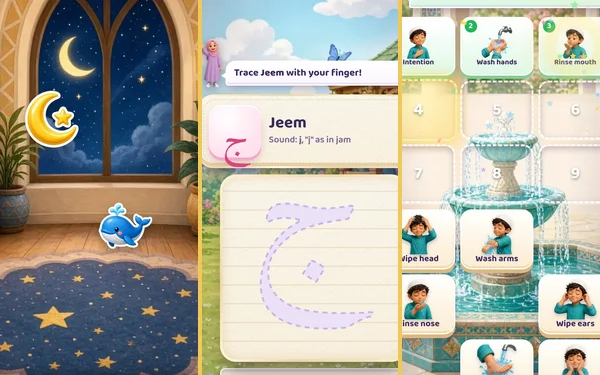
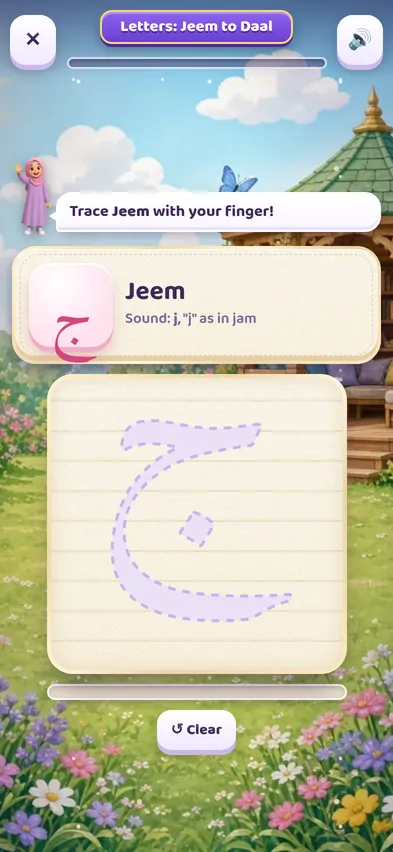
Letter Garden (Arabic letters). Seven rounds cover all 28 letters of the Arabic alphabet, four at a time, in the usual order from Alif to Yaa. Your child traces each letter with a finger, sees its name and a simple English hint for its sound (for example Jeem, "j as in jam"), then pops the bubble with the letter that is named. There is no letter audio, because a computer voice cannot say Arabic sounds well enough, so this is a lovely round to sit with your child and say the sounds together.
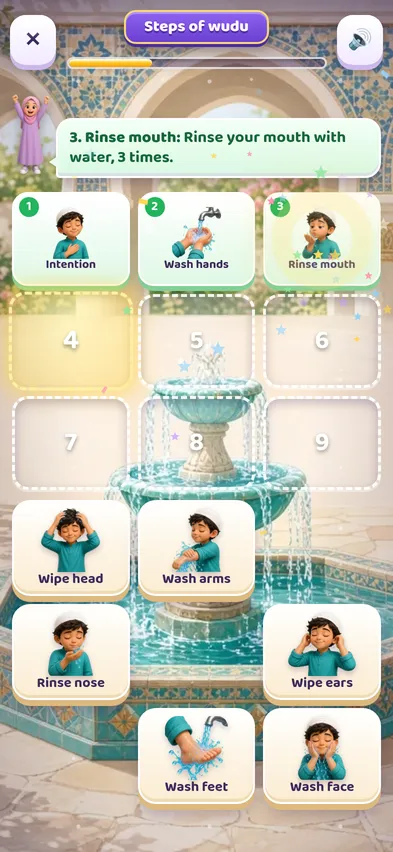
Wudu Fountain (washing for prayer). Picture cards show Sami doing each step: the intention and Bismillah, hands, mouth, nose, face, arms to the elbows with the right first, wiping the head and ears, and finally the feet. Your child drags or taps the cards into order, then answers a short quiz.
Prayer Hall (how we pray). The same card idea walks through one rak'ah and the ending: takbeer, standing and reciting Al-Faatihah, rukoo', standing up, sujood, sitting, the second sujood, Tashahhud and salaam. A line explains how many rak'ahs each of the five daily prayers has. A quiz follows.
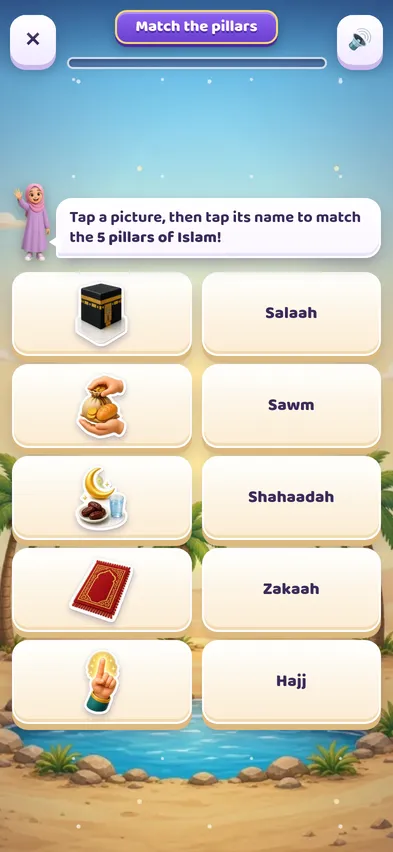
Five Palms Oasis (the five pillars). Your child taps a picture, then taps its name, to match Shahaadah, Salaah, Zakaah, Sawm and Hajj. Each pillar has a short, child-sized explanation, and a quiz checks what stuck.
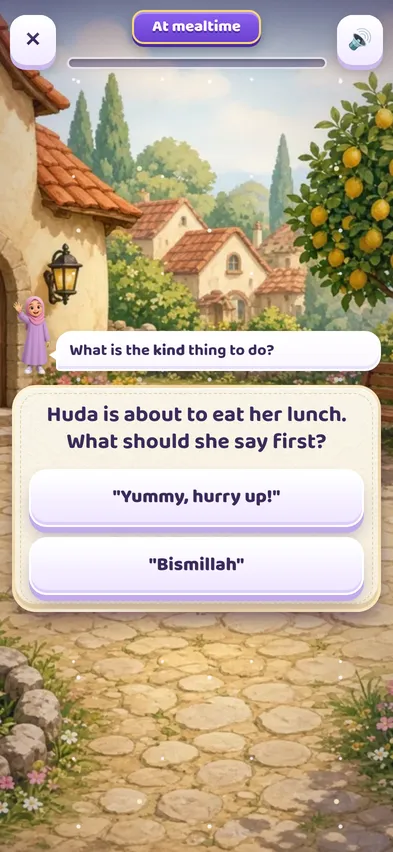
Kind Village (good manners). Three little scenes, at mealtime, greeting friends and being kind and honest, ask what Huda or Sami should say or do. Choices include saying Bismillah before eating, replying to salaam, saying Yarhamukallaah when someone sneezes, thanking people and being gentle with animals.
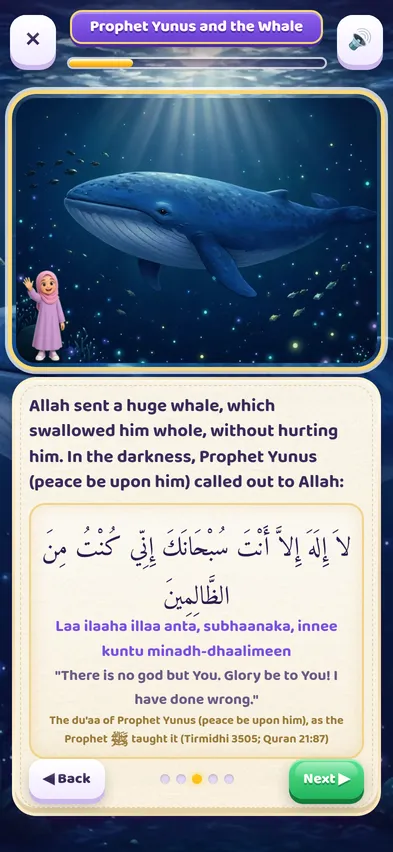
Story Shore (stories of the Prophets). Three stories from the Quran: Prophet Nuh and the ark, Prophet Yunus and the whale, and Prophet Ibrahim, who taught his people about the One who made the stars, the moon and the sun, and later raised the walls of the Kaaba with his son Isma'il (peace be upon them all). Each story ends with three small questions.
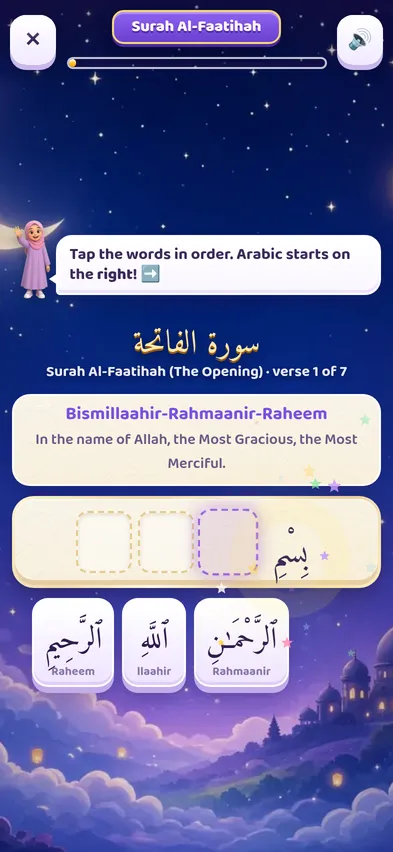
Quran Hill (short surahs). Al-Faatihah, Al-Ikhlaas, Al-Falaq and An-Naas. Your child taps the words of each verse in order, starting from the right, with a transliteration and a simple meaning under the Arabic.
How the religious content was prepared
We know that parents care most about getting this right, so here is exactly what we did. The Quran text is the standard Uthmani script (the Hafs reading) and it was checked word by word against quran.com. It was never typed out by hand. The meanings are simplified for children from the Saheeh International translation, and the transliteration is only a reading aid, not a tajweed guide.
No Prophet, companion or angel is ever drawn, and Allah is never pictured. The stories are told with paintings of scenery, objects and animals: the ark and the animals, the storm, the whale in dark water, the gourd vine on the beach, the night sky. The only people you will see are Huda and Sami, two made-up children who show the steps of wudu and salah. The name of every Prophet is followed by "peace be upon him".
There is no recitation audio and no music, only soft chimes, which can be switched off in Settings. The optional read-aloud voice reads the English sentences only, never the Arabic.
Follow your own family's way
Muslims pray in slightly different ways depending on the school they follow, for example where the hands rest or what is recited behind an imam. Noor Quest keeps those parts simple and general. Please show your child the way your own family and teachers do it, and treat the game as a friendly helper alongside them, not a replacement for a teacher, a masjid class or learning at home.
The Parents panel
On the title screen, tap 👪 Parents. The panel explains everything above in a few short paragraphs: what the game covers, how the Quran text was checked, the no-pictures rule, the note on different schools, and a short how-to-play for every land. It also explains that progress stays on your device. If you want to start again, for example for a younger brother or sister, open Settings and tap Reset twice.
Tips for kids
- Say "Bismillah" before you start a round, just like Huda!
- In Quran Hill, Arabic goes from right to left. Look for the first word on the right.
- Not sure? Tap the 🔊 button and the guide will read the question to you.
- Try again for three stars. Every land has a bonus sticker waiting.
- Show a grown-up your room when you have filled it with stickers.
Questions parents ask
Is it free? Yes. There is nothing to buy and no adverts appear while your child plays.
Does my child need to read? Not much. The read-aloud button reads questions and stories in English, and most rounds are about tapping and dragging pictures.
Can my child learn to recite from it? It helps with recognising letters and the order of words, but please recite the surahs with your child or a teacher, since the game has no recitation.
What age is it for? It is made for young children who are just starting to learn. The youngest players do best with a grown-up beside them, and older children often like racing for three stars in every round.